Any links to online stores should be assumed to be affiliates. The company or PR agency provides all or most review samples. They have no control over my content, and I provide my honest opinion.
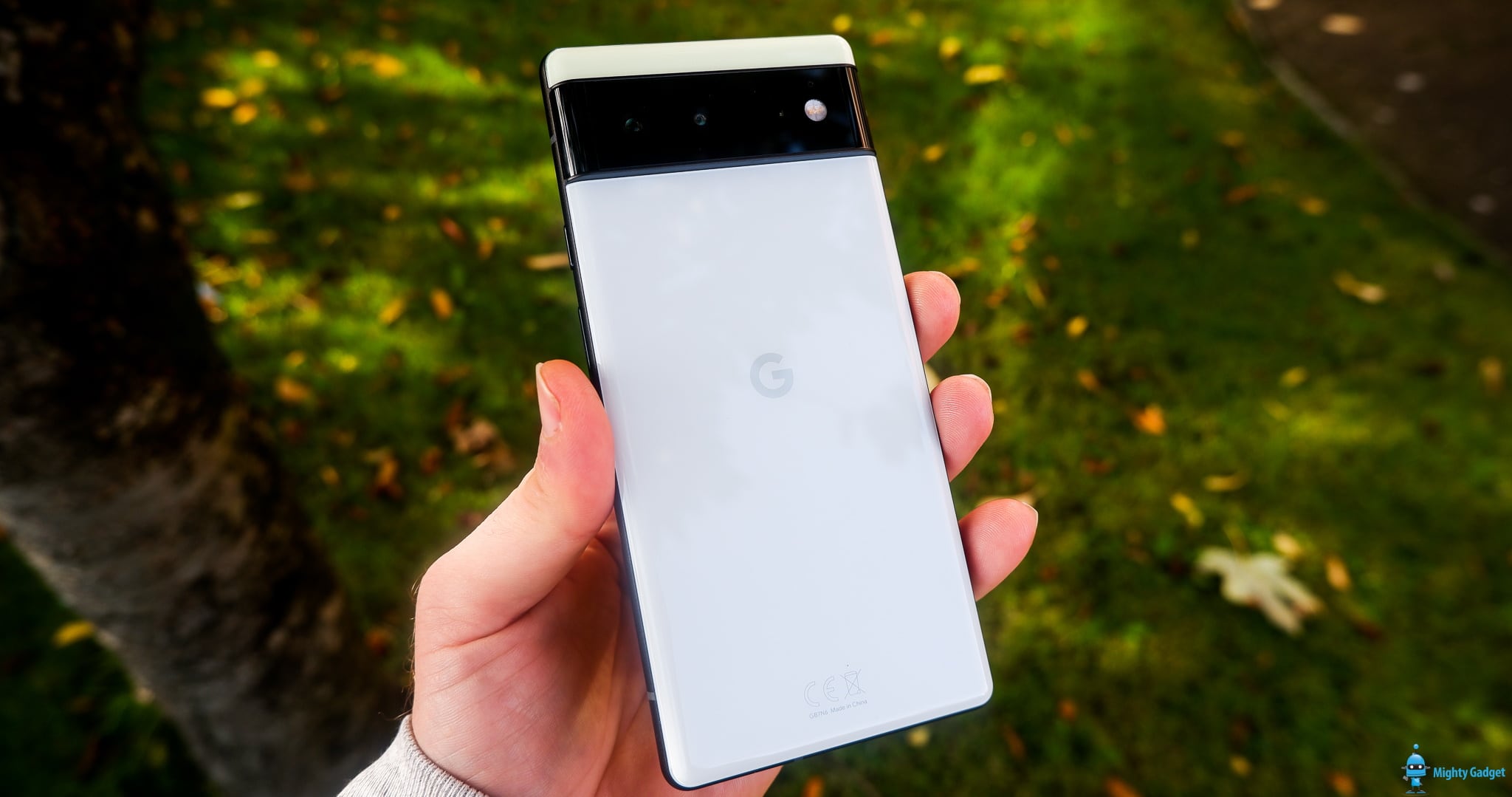
The Google Pixel 6 started shipping this week, being the first phone to use the custom Google Tensor chipset. This is the biggest upgrade for the Pixel series in years, and many people are already claiming that the Pixel 6 Pro is the best Android phone of the year.
The Google Tensor uses some similar specs as the Qualcomm Snapdragon 888 and the Samsung Exynos 2100 and will certainly be a very powerful chipset that will handle the most demanding of tasks, but how good is it compared to the other flagship chipsets of this year?
I will preface these results stating that benchmarks are really not the best indication of real-word performance. Some brands optimise the phones to perform well in benchmarks, and benchmarks such as 3DMark Stress Testing will push the phone beyond what most normal users will ever do in real life. However, as inaccurate as they may be, they do provide some objective numbers which help guide my reviews rather than me trying to explain the performance of one phone from another clumsily.
[amazon box=”B09G77DR7C,B07CCGZSQV” template=”table” filterby=”price”]
Specification
[table id=370 /]
Google has gone a bit left field with the design decisions for the Tensor. It is the only chipset to run two of the new high powered Arm Cortex-X1 CPU cores but then pairs them up with somewhat outdated Arm Cortex-A76.
The GPU design is also a monster with 20 processing cores 42% more than the Samsung Exynos 2100.
Antutu
[table id=374 /]
The Antutu results don’t look overly favourable when compared to the Qualcomm equipped phones. I have included three SD888 phones on the list to show the relatively large difference in performance, with some brands pushing the chipset a bit harder. The gaming-focused Red Magic phones have a significant performance emphasis over battery efficiency.
Geekbench
[table id=306 /]
I reused one of my old tables here. With this one, you can see how well the Tensor chipset performs against the Snapdragon 765G which was used on the Pixel 5. A 70% and 55% performance difference between the Pixel 6 and the Realme X50 with the SD765G.
In comparison to the other flagship chipsets, Geekbench results were somewhat predictable. The two Arm Cortex-X1 cores are clocked lower than the single Cortex-X1 on the Qualcomm and Snapdragon, giving them an advantage for the single-core.
Similarly, the inclusion of the A76 cores drops the overall multi-core performance. However, it is still a perfectly respectable result.
3DMark Wildlife – Stress Testing & Thermal Throttling
[table id=373 /]
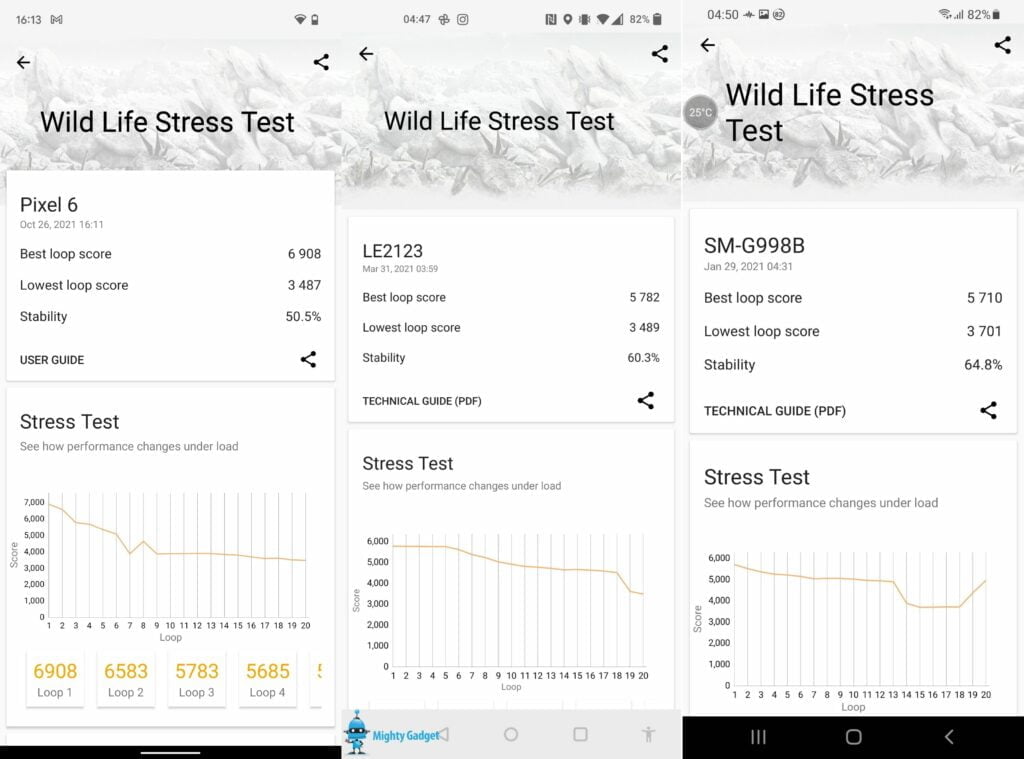
The 3DMark Wild Life stress test is where things get quite interesting. The Google Tensor has both the best and worst performance of the year. With a high score of 6908, that is almost 20% ahead of the OnePlus 9 Pro with the SD888 and 26% ahead of the Samsung with the Exynos 2100.
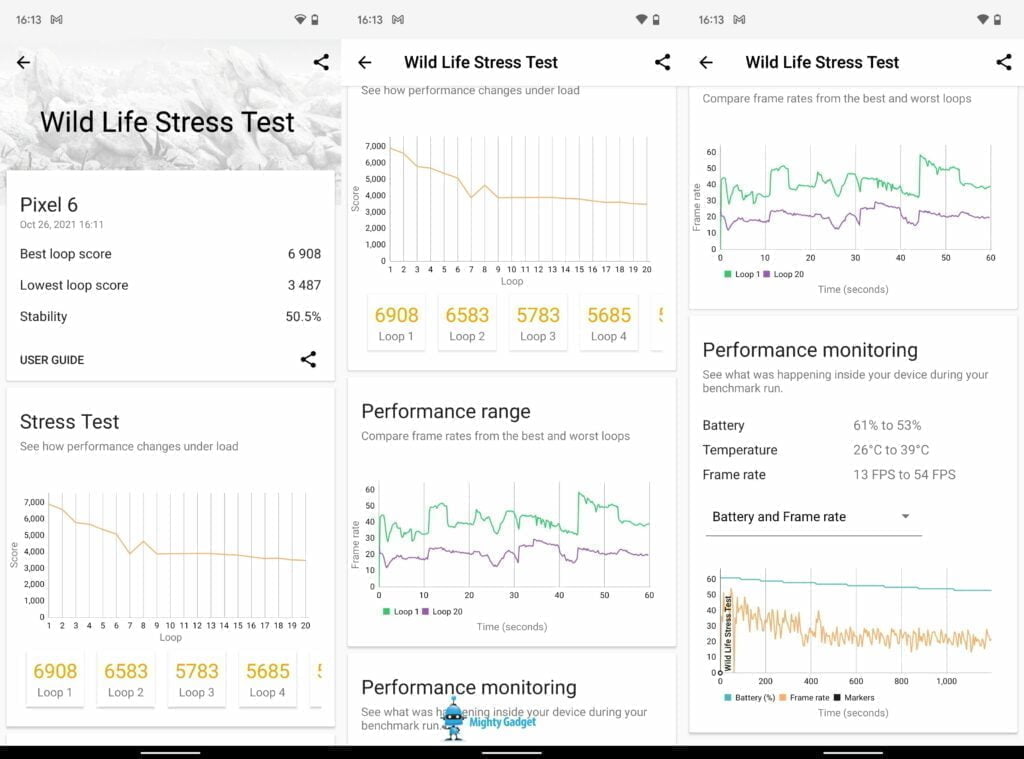
However, it has the worst stability score of the year, with the final run being almost half of the high score. Looking at the graph, there is a sharp decline immediately, with the scores starting to stabilise out at around 9 minutes.
For the OnePlus 9 Pro loop graph, you have a fairly stable result for 6 minutes, a slight decline up to 18 minutes, then a steep decline for the last two. So, this may be a bit lower overall, but the sustained performance is better.
The Pixel 6 is obviously amazing for very short bursts, being significantly more powerful than competing brands. However, that sharp decline will likely be something that affects real-world performance in things like gaming. How much you will notice this, is another question. The phone still has plenty of power even when fully throttled.
One thing that is worth noting, the Pixel 6 peaks at 39-degrees and loses about 8% of battery during the test. Other phones run both hotter and have higher battery drain. For example, the OnePlus 9 Pro hit 41-degrees, but the Red Magic 6R (which had almost no throttling) hit 59-degrees and dropped 18%.
PCMark 3.0 Work and Battery Testing
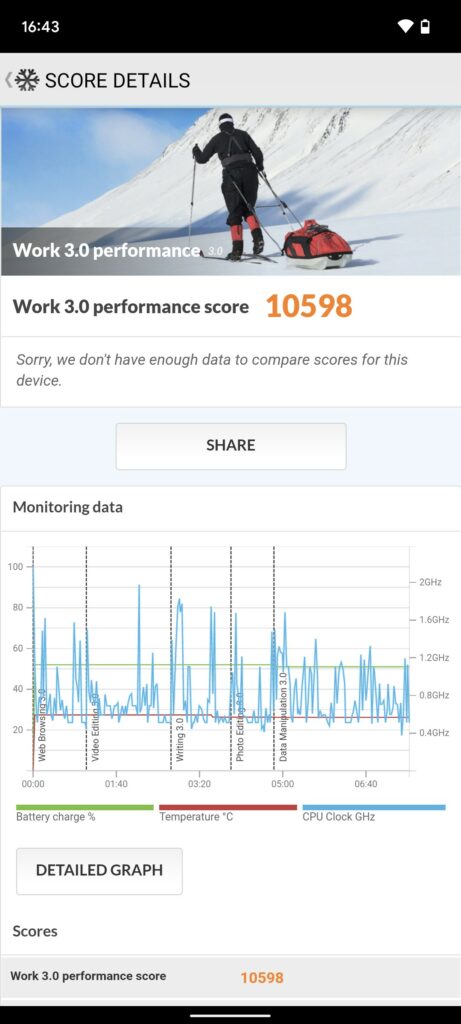
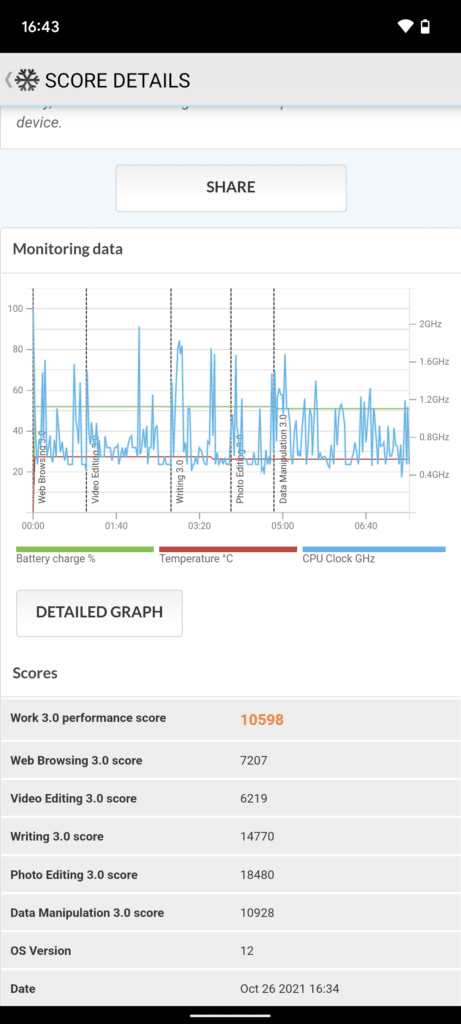
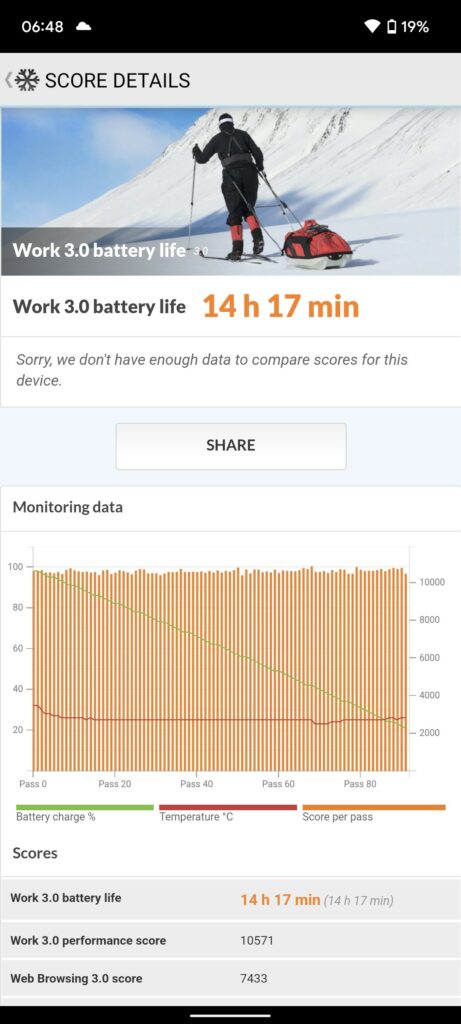
PCMark results vary wildly between brands, even if two different phones use the same chipset. It’s a good indication of both the inaccuracies of benchmarks but you could argue it is a sign of how having a certain chipset doesn’t guarantee a specific level of performance.
An example of this would be the Qualcomm Snapdragon 778G which achieved 9195 with the Realme GT Master but 12177 with the Honor 50.
For the Pixel, with a score of 10598, the Tensor achieves an admirable result while keeping the CPU clocks quite low when you look at the graph.
AI Benchmark

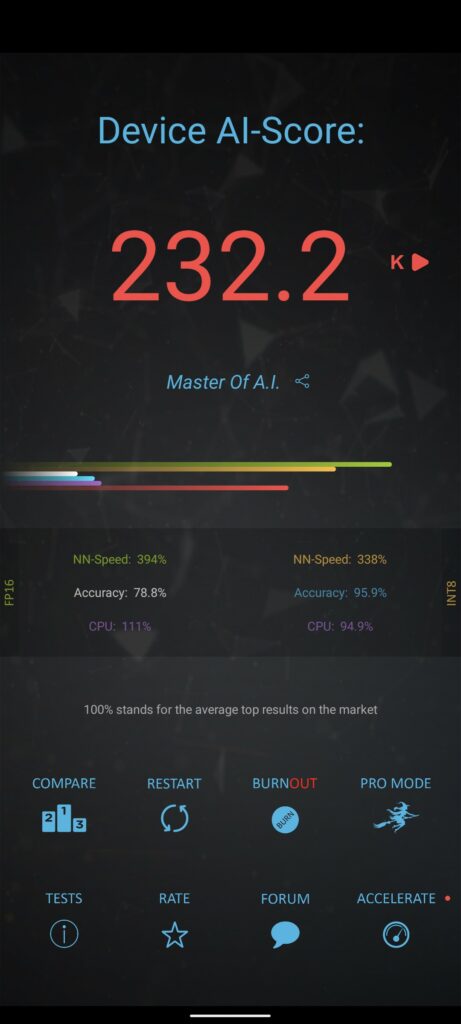
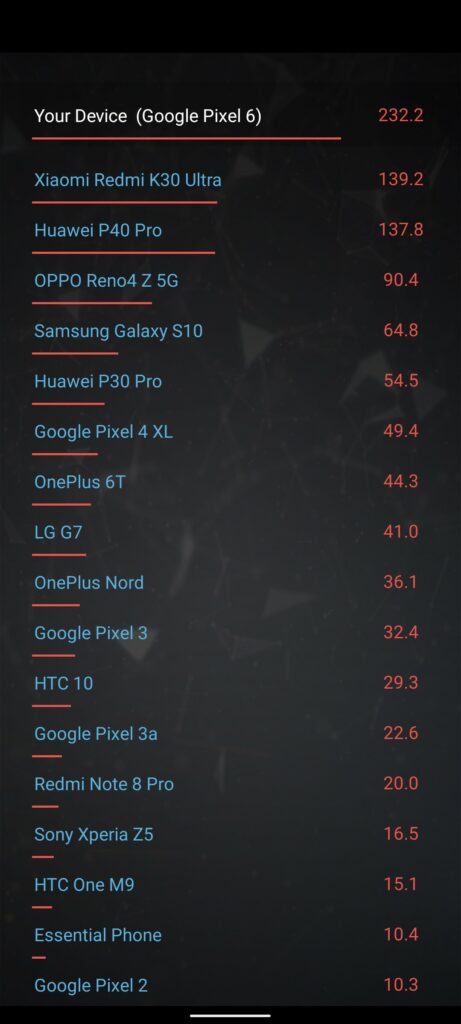
One of the Pixel 6 series selling points and the Google Tensor is its AI processing ability.
The Ai-Benchmark.com app has in the past had some questionable results and is another good example of the issues faced when using benchmarking apps.
It significantly favours the FP16 results. In the past this has meant that Huawei/HiSilicon Kirin chipsets have dominated the results, even though the Snapdragon chipset performs better with the INT8 scores.
The Google Tensor has some along and dominated this benchmark. Largely thanks to the absolutely massive FP16 results. However, they also score highly on the IN8 scores, not a high as the SD888 but not far off, and significantly higher than the Kirin 9000.
Overall
The Google Tensor performs about as well as I had expected. It doesn’t offer quite the same level of raw power as the Qualcomm Snapdragon 888, but I don’t think Google was ever positioning it as the most powerful chipset.
The thermal throttling issues were somewhat predictable, it happened on the SD888 and the Exynos 2100. It seems that the Cortex-X1 and/or Samsung 5nm fabrication process isn’t very good for efficiency. If or how much this affects real-world performance is another question. I suspect not much.
Google massively increased the battery sizes this year, but due to the power of the Tensor chipset, I suspect that the overall performance won’t be quite as good as I would have liked. Early benchmarks for this look OK, but I need more time with it to see how I feel about real-world performance.
Overall, it is an impressive start for Google’s custom chipset, but there is obviously a lot of room for improvement.

![TRENDnet 5 & 8 port Unmanaged 2.5G Switch Switches launched – Another new affordable multi-gig switch [TEG-S380 & TEG-S350]](https://old.mghty.uk/wp-content/uploads/2021/03/TRENDnet-Debuts-25G-Switches-768x384.jpg)