Any links to online stores should be assumed to be affiliates. The company or PR agency provides all or most review samples. They have no control over my content, and I provide my honest opinion.
I previously compared the three flagship system on chips from Huawei, Qualcomm and Samsung against each other and at the time, on paper, the Kirin 970 was fractionally behind the other 2 SoCs, which was due to the Kirin 970 being announced 6 months prior.
Now the tables have turned and the HiSilicon Kirin 980 is the newest chip to hit the market with the Snapdragon 845 and Exynos 9810 being 6 months out of date.
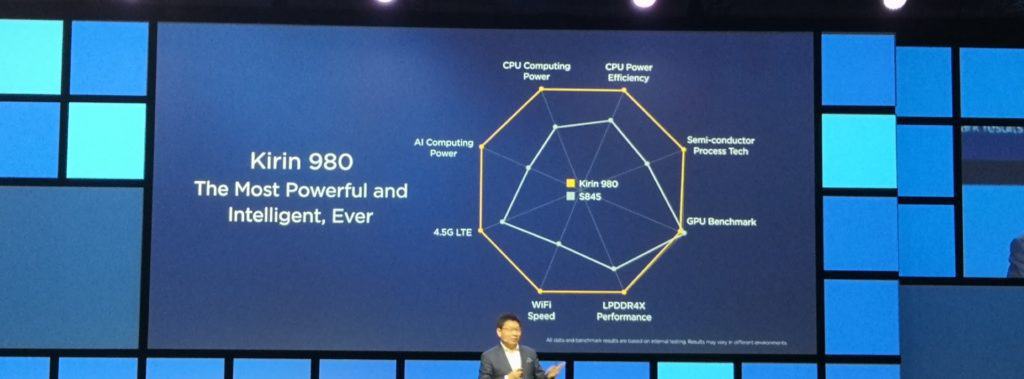
During the Huawei keynote at IFA, they made many comparisons to the Snapdragon 845 showing how it was better in every way. One graph even summarised how the 980 beat the 845 in every category possible. The below graph actually indicates that the 845 beat the 980 in the GPU benchmark but this was before Huawei added the GPU boost differences.
At the moment we only know the basic specification of the HiSilicon Kirin 980 so benchmarks and more granular specs are not available yet.
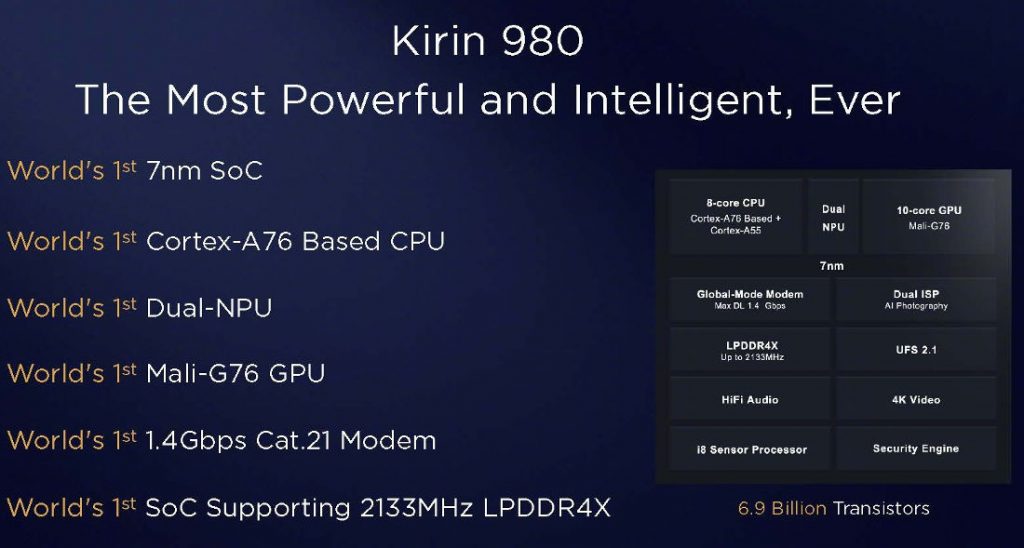
The main comparisons that are worth noting are the 980 is the first chip to use the 7nm process, which means a 60% more transistors int he same size footprint. This logically means it can run faster, cooler and more power efficient than larger processes.
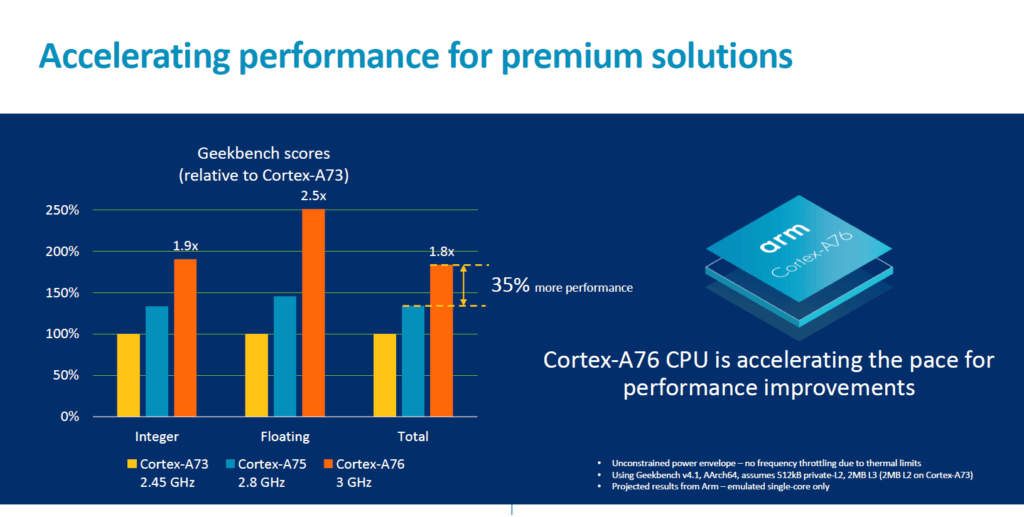
The CPU adopts a new structure, rather than four big, four little, it uses two big, two medium, and four little with all of them being based on the Cortex-A76 which is the first SoC on the market to use this. The clock speeds are a little lower than the Exynos M3 and Kryo 385 but we only need to look at older AMD and Intel chips to understand that clock speed does not necessarily mean a better CPU. A comparison in geekbench scores carried out by Arm between the A76 and A75 shows a 35% improvement or an 80% improvement compared to the A73 found on the Kirin 970. Though it is worth noting the clock speeds used in this test don’t match up with the speeds found in either the 970 or 980.
The Snapdragon doesn’t use a Mali-based GPU but the Exynos does and that uses the older G72 while the Kirin 980 uses the G76. While Huawei did many of its comparisons to the Snapdragon 845, if we look at the generational improvement from the Mali-G72 to the G76, there is a 30% improvement in performance and battery efficiency while also achieving a 2.7x improvement in machine learning. 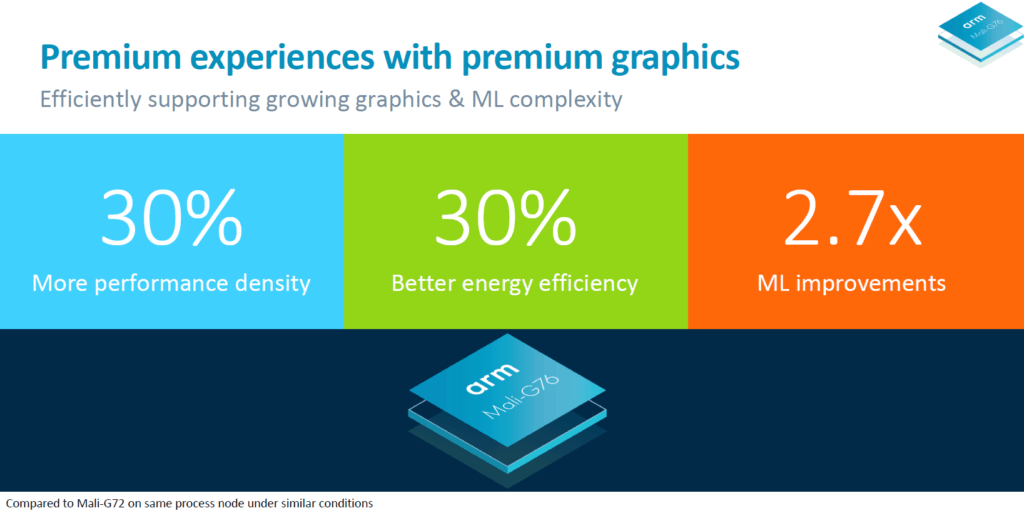
Another key performance indicator is the speed of the LPDDR4 RAM with the Kirin 980 running 13% faster than the memory found in the Snapdragon 845.
Once the Huawei Mate 20 & Pro are launched we will get some more accurate benchmark results, but as always with a flagship SoC nowadays, it will be so good that most users will barely make the most of it. For your average user the main benefits will be the potential battery improvements, which if true, then combined with the rumoured 4200mAh battery of the Mate 20 we could see some truly amazing battery performance results from the new phones.
[table id=10 /]