Any links to online stores should be assumed to be affiliates. The company or PR agency provides all or most review samples. They have no control over my content, and I provide my honest opinion.
I recently received the Google Pixel 8 Pro to review, which will likely be completed by the end of next week.
In the meantime, I have done my usual benchmarks to give some insight into the performance of the new Google Tensor G3.
Blocked Benchmark Apps
Shortly after the Pixel 8 series was launched, it was reported that Google had blocked many benchmarking apps, including Geekbench and 3D Mark, from running. There was no official statement on why this was, but there were a few theories.
- It is easy to jump to the conclusion that Google did this deliberately to hide the fact that the Tensor G3 is not as good as other flagship chips, namely the Snapdragon 8 Gen 2.
- A similar but alternative view was that Google has put a lot of emphasis on the AI features of the chipset, and these benchmarks are not representative of that.
- The last explanation, and the most likely, was that those apps just weren’t compatible with the Pixel 8 series at launch.
Since the block was reported, all the usual benchmarking apps can be installed.
Edit – It has now been reported that Google did block the benchmarking apps during the review embargo period.
Benchmarking Caveats
Considering the uproar about the blocked benchmark apps, I feel I should highlight that the following benchmarks are deeply flawed and don’t necessarily represent real-world performance.
Different phones using the same chipset can often score wildly different results. This will likely be due to the way manufacturers will vary performance based on specific tasks. In the past, some brands have cheated benchmarking results by making the phone run at a higher-than-normal performance to achieve better results. A less sinister situation is that some brands focus more on performance than battery. You can see this with RedMagic phones, which often outperform other phones but run much hotter and use much more battery during a benchmark.
I still do benchmarks because they are easy to do and work reasonably well as a guide. Sadly, I just don’t have the time or readership to spend hours doing a deep dive analysis or real-world performance.
Google Tensor G3 vs G2 vs Tensor vs Snapdragon 8 Gen 2 Specification
[table id=601 /]
The Google Tensor G3 has a significant upgrade compared to its predecessors. The G2 was barely an upgrade from the original Tensor, so the Pixel 8 series feels like a proper upgrade from the Pixel 6 I was previously using.
The 9-core design is particularly interesting, and I would assume it has been implemented this way for efficiency.
As someone who writes about networking and WiFi a lot, I am glad to see that WiFi 7 is included. The Qualcomm Snapdragon 8 Gen 2 may support it, but it is not guaranteed, my Honor Magic5 Pro doesn’t even have WiFi 6E.
Benchmarks
Antutu
[table id=549 /]
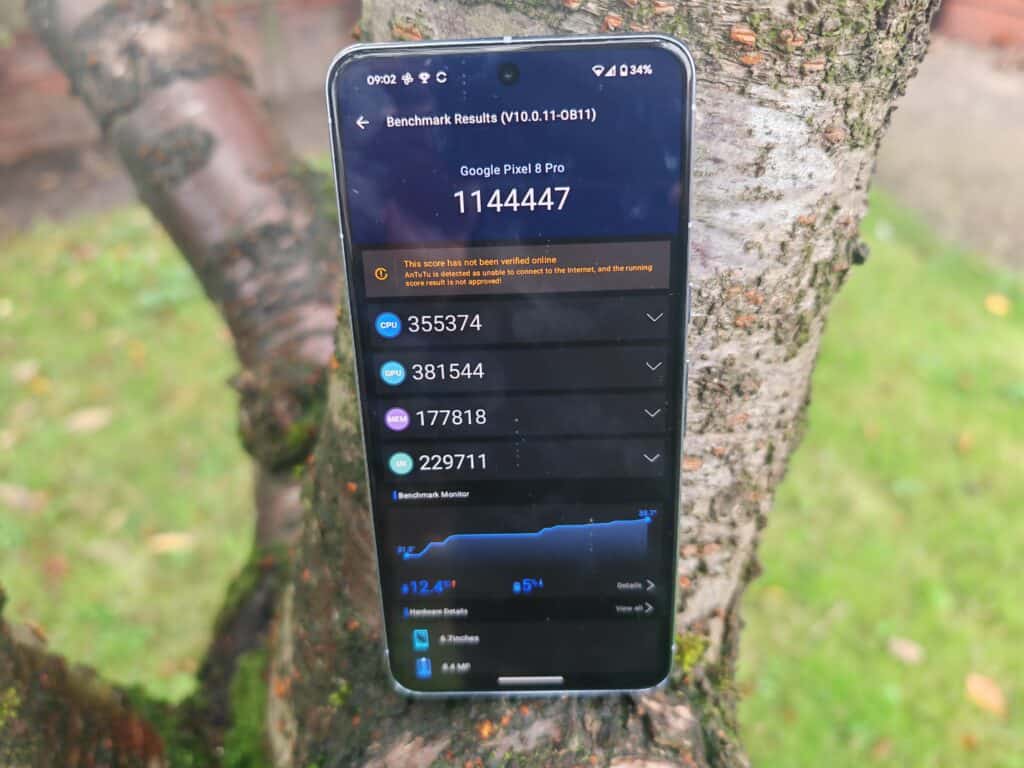
In Antutu, the Google Tensor G3 on the Pixel 8 Pro, scores a respectable score of 1,144,447, but this falls short of 1,367,374 Qualcomm by 16%.
The score breakdown reveals some interesting differences: the CPU score on the Tensor G3 is 19% higher, but the GPU score is 35% lower.
There is a significant improvement from the Tensor and Tensor G2 with a score that’s 35% higher than the Pixel 7 Pro.
Geekbench 6
[table id=593 /]
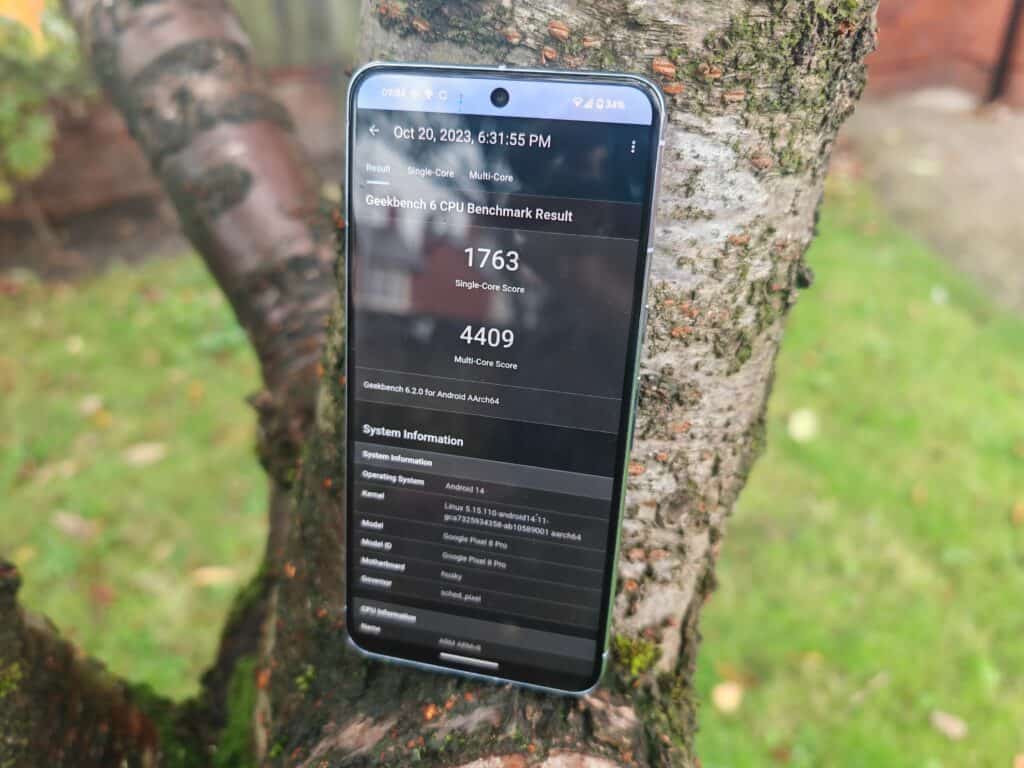
For Geekbench 6, I initially thought the Google Tensor G3 may perform better than it did due to the 9-core design. I at least thought it would score a higher multi-core score. The Qualcomm chipset may have fewer cores, but all the cores are clocked quite a bit higher than the Tensor G3.
The end result is that the Qualcomm chipset scores 11% and 19% higher than the Tensor G3 for single and multi-core, respectively.
You have a substantial improvement of 25% and 29% going from the G2 to G3.
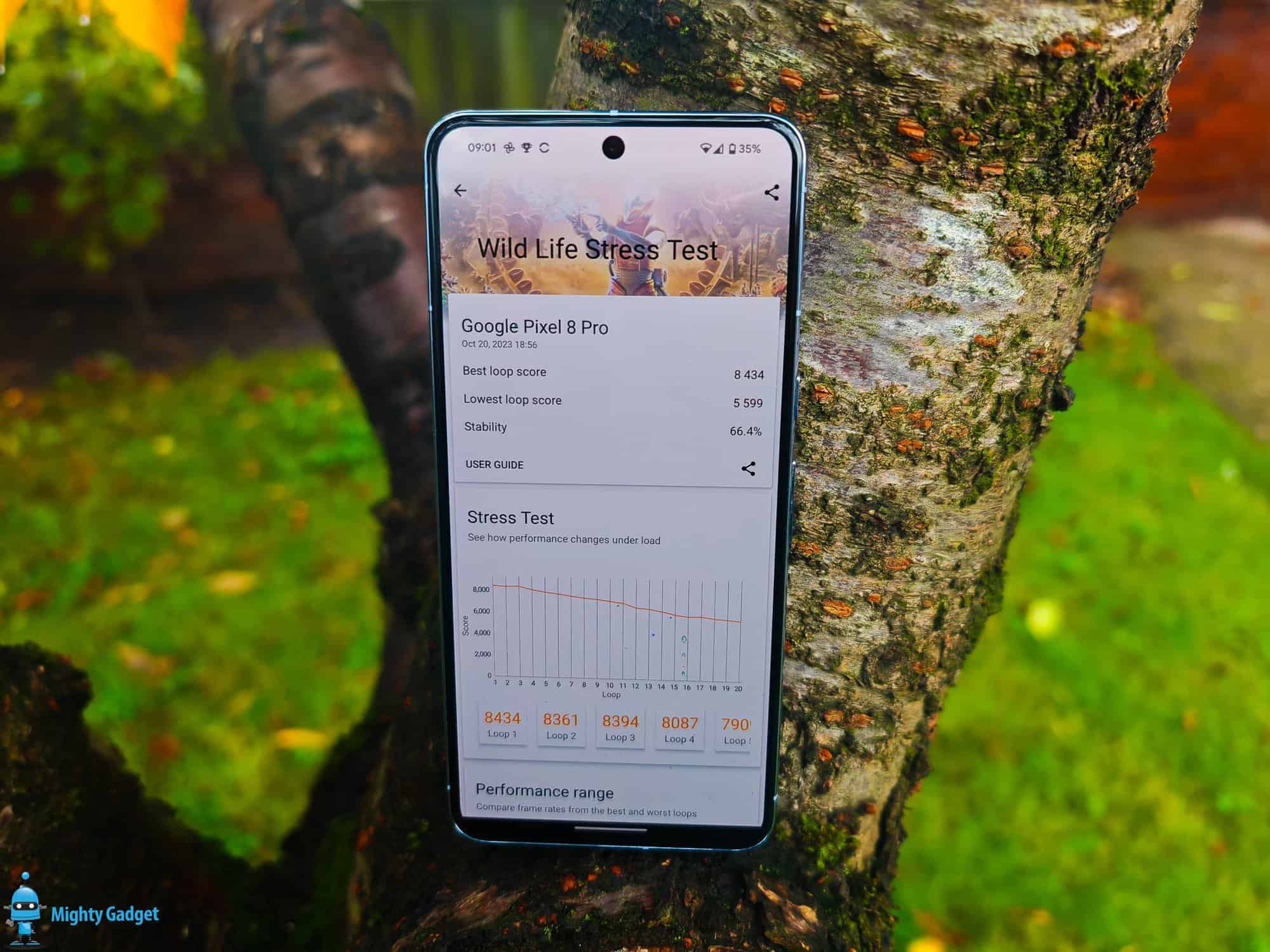
3DMark Wildlife Stress Testing / Thermal Throttling
[table id=373 /]
For the 3DMark Wildlife Stress Testing, I have reused an old table with quite a lot of phone benchmarks on it.
The Qualcomm chipsets are clearly better for gaming than the Google Tensor chipsets. The Snapdragon 8 Gen 2 scores 51% and 53% higher for the low and high scores with a similar stability level.
PC Mark Performance and Work 3.0 Battery
[table id=332 /]
I always find that the PC Mark results are all over the place as they are highly dependent on how a manufacturer handles different workloads. Some brands score suspiciously high scores.
I think the important thing here is that the Pixel series has improved the battery times with each generation, with a significant improvement since the Pixel 6. However, the performance score has only improved negligibly, with a 5% improvement going from the G2 to G3.
AI Benchmarks
For the AI benchmarks, I only had access to the Pixel 8 Pro, Pixel 6 and Honor Magic 5 Pro.
With the AI benchmarks, things can get a little confusing. The Google Tensor G3, uses the Android Neural Networks API (NNAPI) that is built into Android.
Qualcomm chipsets have their own neural network library, and the problem here is that a developer needs to apply to Qualcomm to be allowed to use it. This ends up meaning the Snapdragon 8 Gen 2 can perform significantly better than the Tensor G3 if the application has access to those libraries.
Geekbench ML
- Pixel 8 Pro: 2122
- Pixel 6: 1989
- Honor Magic 5 Pro: 562
In the case of Geekbench ML, it appears the Snapdragon 8 Gen 2 on the Honor falls back to CPU rather than using NNAPI, which results in a significantly worse performance than either of the Pixel phones.
As for the difference between the Pixel 6 and 8 Pro, the 6.7% uplift in performance is quite poor, considering the chipsets are two generations apart.
AI Benchmark
- Pixel 8 Pro: 718
- Pixel 6: 337
- Honor Magic 5 Pro using Qualcomm Libraries: 1870
- Honor Magic 5 Pro using NNAPI: 135
AI Benchmark has access to the correct neural network library for Qualcomm, which allows it to achieve a substantially higher score than the Google Tensor chipsets.
The Honor Magic 5 Pro score is over 2.5 times higher than the Pixel 8 Pro.
Toggling off the Qualcomm libraries and attempting to use the same NNAPI as the Pixel phones, the score plummets 93% down to 135, which is also 81% lower than the Pixel 8 Pro. Switching to GPU acceleration improved the score to 359.
However, at least the Pixel 8 Pro scores a significantly larger score than the Pixel 6 with over double the score.
Overall
Based on benchmarks alone, the Google Tensor G3 is certainly inferior to its Qualcomm counterpart.
There is more to it than that, though. Google don’t seem to make quite a big deal about their chipset being the absolute best in raw performance like other chipset brands. If you look at any of the marketing pages from Google for the Pixel 8 Pro or the Google Tensor G3, there is no mention of things like gaming; they are not advertising things like Ray Tracing or anything like that.
The focus is predominantly on AI and photography. While many people think the focus of on-device AI is a bit of a scam, there is no denying the prowess of Pixel phones for photography.
From my personal perspective, I don’t game much, and my phone is mainly used for productivity and photography. Phones are so powerful nowadays I don’t really feel a great deal of benefit about new chipsets; until recently, I was quite content with my Pixel 6, though I was getting frustrated with its battery.
I have since moved to the Honor Magic5 Pro, which I love. Now, I am using the Pixel 7 Pro, which, according to the above benchmarks, has an inferior chipset than the Honor. However, I have noticed absolutely no difference in perceived performance (it is early days, though).
So far, I am more than happy with the Pixel 7 Pro, it is a huge improvement from the Pixel 6, mainly because I absolutely hated the fingerprint sensor on the Pixel 6, while the Pixel 7 Pro works perfectly and has the added benefit of facial recognition.