Any links to online stores should be assumed to be affiliates. The company or PR agency provides all or most review samples. They have no control over my content, and I provide my honest opinion.
3DMark Wildfire Stress Testing & Thermal Throttling
[table id=524 /]
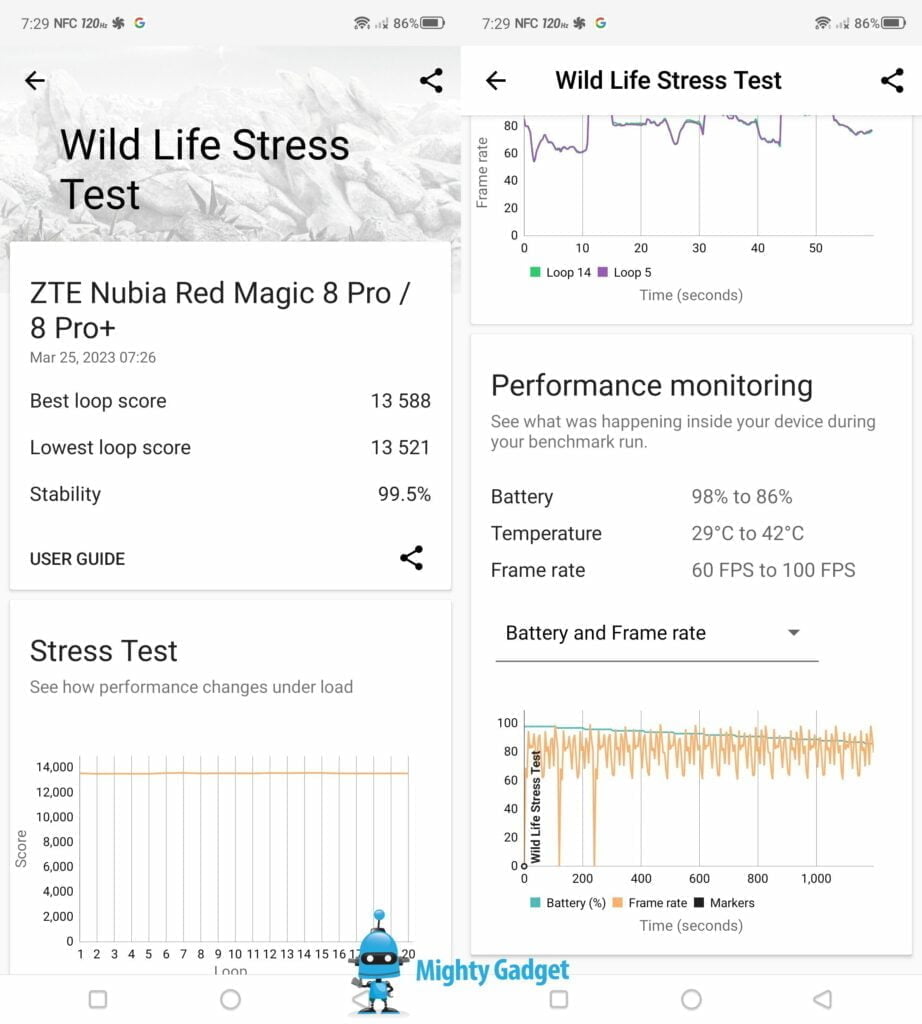
For the 3DMark Wildfire Stress Test, we see a significant improvement across the board. There is a massive 26.9% improvement with the best score, and the phone doesn’t throttle the performance later on in the test. Therefore, the lowest score is 31.6% from the previous generation.
It would seem that the chipset is significantly more efficient and aided by active cooling. I did multiple tests, the first test had the temperature start at 21°C and peak at 39°C. That’s 10°C cooler than the maximum temperature of the Redmagic 7S Pro. In the second test, the phone started at 29°C and peaked at 42°C. Again, this is well below the previous generations and a much smaller temperature change.
The battery drops just 12% points, which is also much lower than the previous generation, but you will also want to factor in the fact that it has a bigger battery. A quick bit of maths would indicate that the Redmagic 7S Pro used 900mAh while the Redmagic 8 Pro used 720mAh. The older Redmagic 7 Pro used more than double at roughly 1550mAh.
Geekbench
[table id=439 /]
Geekbench has been upgraded to V6, and the results are not the same between versions. You can still get Geekbench 5 on the Playstore, and the above results are from that.
This is a good example of how different benchmarks vary and you should take everything with a pint of salt. The CPU performance in this benchmark is significantly better than what was implied with the Antutu benchmark. There has been a 12.2% uplift in the single core score and an impressive 23% improvement with the multi core.
In Geekbench 6, the Redmagic 8 Pro achieves:
- Single Core: 1980
- Multi Core: 5627
PCMark 3.0 & PCMark 3.0 Battery
In PCMark 3.0 the phone achieves a score of 12652 in the Work 3.0 benchmark. This is lower than the score I achieved with PCMark 2.0 on the previous phones. This could be a change in the benchmark, but it is equally likely that Redmagic has tuned the phone better to manage its performance. You don’t need the phone going full throttle for day-to-day tasks.
Unfortunately, I have not been able to do a successful run of the PCMark 3.0 battery test, yet. It froze at 50% when I did my first run.
Overall
As you’d expect, the Qualcomm Snapdragon 8 Gen 2 provides a significant performance boost compared to last years flagship chipset.
For me, the most important thing is that Qualcomm is using TSMC for the fabrication process, and the new Qualcomm Snapdragon 8 Gen 2 is not just incredibly powerful but much more efficient than it would have been if they had used Samsung.
Qualcomm is in a strong position this year. Samsung has bowed out of the flagship chipset market for now. MediaTek is biting at their heels; the MediaTek Dimensity 9200 should have comparable performance to the Snapdragon 8 Gen 2, but MediaTek was very vague about the Dimensity 9200 being used on any flagship phones in western markets this year.